TL;DR
In 1708, a powerful ascetic named Madho Das met Guru Gobind Singh Ji at Nanded. Madho Das had spent years renouncing the world, mastering occult practices, building a reputation. Within a single meeting, he was remade — not into a better ascetic, but into something he had never been: a soldier for justice. He became Banda Singh Bahadur, the first Sikh military leader to challenge the Mughal empire. The story raises a real question: can a person fundamentally change who they are? His life says yes — but not by becoming "more" of what they were. By being turned in an entirely new direction.
A man who had already remade himself once
Before he was Banda Singh Bahadur, before he was even Madho Das, he was Lachhman Das — born in 1670 in Rajauri, in the Jammu hills. As a young man he loved hunting.
The turning point, as the tradition tells it, came on an ordinary hunt. He killed a deer — and watched it die. Something in that death broke something in him. He could not continue the life he had been living.
So he left. He became a wandering ascetic, took the name Madho Das, and gave himself to renunciation. He studied under other ascetics. He learned occult and tantric practices. Eventually he settled far south, at Nanded on the banks of the Godavari river, and built a dera — a monastery — where he meditated, gathered disciples, and developed a reputation for spiritual power.
By any measure, this was already a transformed life. The hunter had become the hermit. He had remade himself once.
But the renunciation, for all its discipline, had a quality worth noticing: it was a turning away. Away from violence, away from the world, away from attachment. It was real, but it was a withdrawal.
The meeting
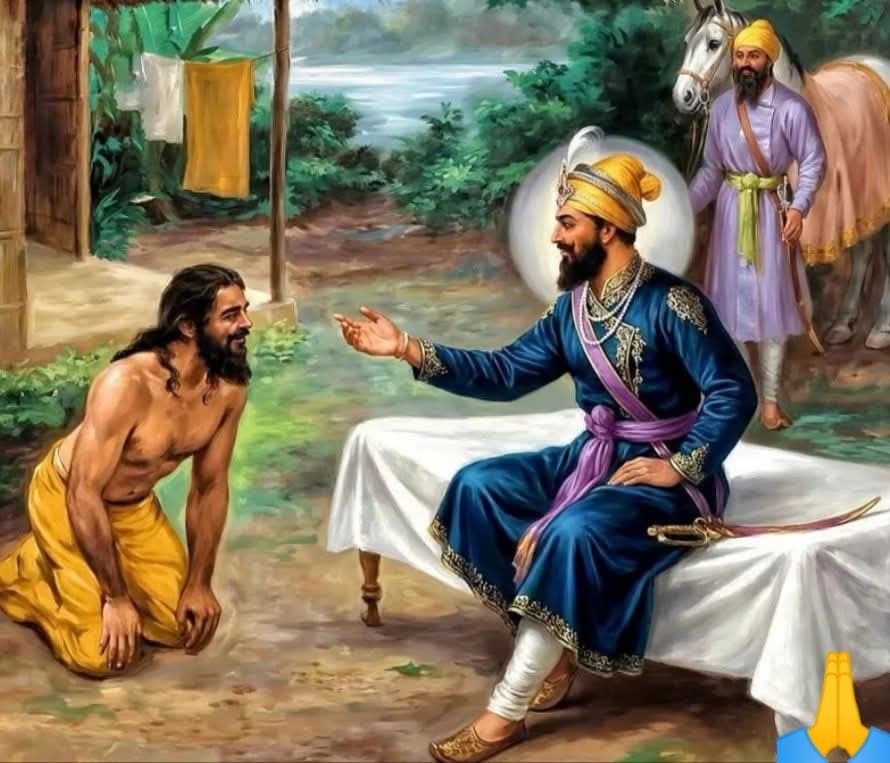
In 1708, Guru Gobind Singh Ji traveled south and camped at Nanded. He heard of the ascetic with the formidable reputation, and he went to the dera.
Madho Das was not there. The Guru, with his Sikhs, entered and sat — on Madho Das's own cot, the seat of his authority.
When Madho Das returned and found a stranger occupying his seat, he was enraged. He reached for the powers he had spent years cultivating — the occult practices, the tantric methods — and turned them on the visitor, meaning to humiliate him, to throw him from the cot.
Nothing worked.
The sources differ on the exact details of what passed between them. But they agree on the outcome. The powers failed, and in their failing, something became clear to Madho Das: the person sitting calmly on his cot was not someone he could move. The relationship was the other way around.
He submitted. In the words the tradition records, he said: "I am your banda" — your slave, your servant. And from that word, his new name was born.
What actually changed
Here is the part of the story worth slowing down for.
Guru Gobind Singh Ji did not make Madho Das into a better ascetic. He did not deepen the renunciation. He turned it inside out.
The man who had spent his life turning away from the world was given a mandate to turn toward it — to go to Punjab, where the Mughal administration was carrying out atrocities against the innocent, and to fight for justice. The Guru gave him a sword, a banner, a drum, five arrows, five companions, and a name: Banda Singh Bahadur.
The hermit became a general.
This is not a small adjustment of character. It is a reversal. The skills of renunciation — discipline, fearlessness, detachment from outcome, indifference to personal comfort — were real. But they had been pointed at withdrawal. Now they were pointed at engagement. Same capacities. Opposite direction.
Within two years, Banda Singh Bahadur had led the Khalsa to victory over the Mughal forces at Sirhind, established Sikh rule across Punjab, abolished the oppressive zamindari land system, and granted property rights to the people who actually worked the land. The hermit who had once renounced the world was now reorganizing it.
He was eventually captured and tortured to death in 1716, unbroken to the end.
The question underneath the story
Can a person fundamentally change?
The easy answers are both wrong. "People never really change" is too cynical — Banda Singh Bahadur's life refutes it. But "anyone can become anything" is too glib — it ignores how much of the change depended on what was already there.
The honest answer is in the shape of the story. Madho Das did not become Banda Singh Bahadur by adding new qualities. The discipline, the courage, the indifference to his own comfort — he already had all of it. What changed was the direction. A life pointed at withdrawal was turned to face the world.
That may be how real transformation usually works. Not the manufacturing of a new self from nothing — but the turning of the self you already are toward something you had not yet served. The capacities were always there. They were waiting for the meeting that would point them somewhere worth going.
Most of us are not waiting for a Guru to walk into our dera. But the structure of the thing may still hold. The question is less "can I become someone entirely new" and more "what am I already capable of — and is it pointed in a direction worth the cost?"